
“Where should we open the next branch?” is probably one of the questions that keeps aesthetic clinic owners awake at night.
Because this decision is expensive. The lease, the fit-out, the equipment, a whole new team — you pay for all of it upfront, and only find out afterwards whether you chose well. If you did, that's wonderful. If it doesn't turn out that way, it can hurt quite a bit.
So we thought: wouldn't it be good to have a set of data to support that decision? We went and collected data on aesthetic clinics across Bangkok from Google Maps — 1,719 branches from 1,047 brands, covering all 39 districts — and worked through it to see what the locations of these clinics are actually telling us.
This is what the market we're talking about looks like. Each dot is one clinic branch, coloured by brand size. Click a dot for the clinic's name, district and Google rating, or use the panel at the top right to filter to the sizes you care about.
What came out surprised us more than we expected. So that's where the opportunity has been sitting?
Insight 1 — Expanding isn't easy, but it isn't out of reach either
Personally, when I drive past a mall and see the ads for the big-name clinic brands, I catch myself thinking: “Is there even room for a new clinic? These big brands have probably taken the whole market already. And if you wanted to compete, you'd need a fortune for marketing and influencers.”
But when you actually count, the picture is different.
70% of aesthetic clinic brands in Bangkok still have only one branch — precisely, 740 out of 1,047 brands. Only 307 brands, or 29.3%, have expanded beyond a single location.
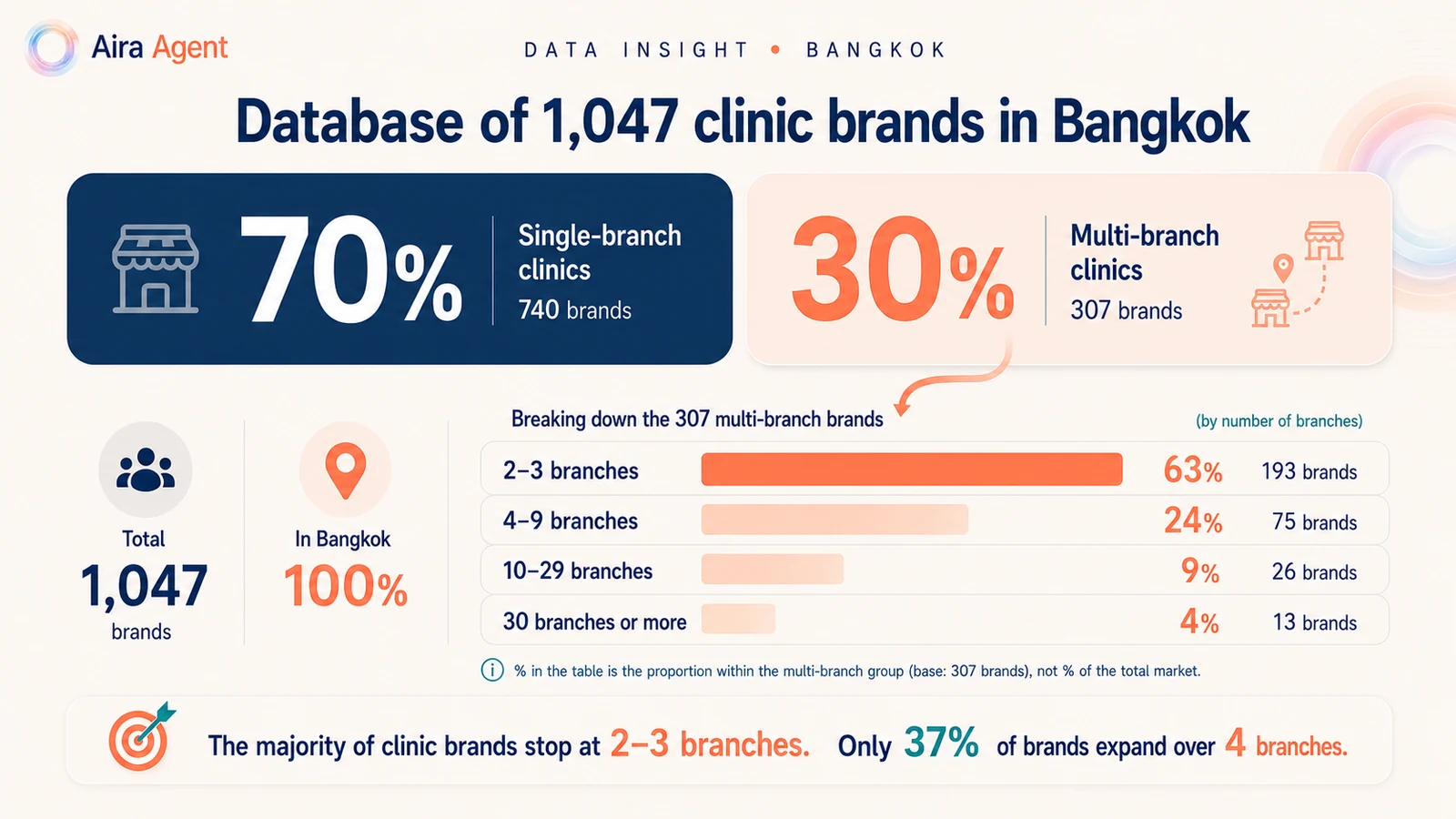
Market overview: 1,047 aesthetic clinic brands in Bangkok — 70% have a single branch
And within those 307 brands that did expand, the picture gets even clearer.
Nearly 2 out of 3 of those who expanded stopped at branch 2–3.
There are two ways to read this. The first is “expanding is hard,” which is true. But the second one matters more, we think: the line most people never cross isn't branch 10 or branch 30 — it sits right at branch 4.
Which means that if you are thinking about a second branch, you are about to join the top 30% of the market, not the 3.7%.
(And the big chains we see in the malls? There are only 39 of those brands — 3.7% of the entire market, in all of Bangkok.)
The real path to expansion starts in a shophouse, not a mall
Another thing the data reveals that few people talk about: what does a second branch actually look like?
- Brands with 30 or more branches → around 50% are in malls
- Brands with 2–3 branches → only 6.6% are in malls
So malls are not the “entrance” to expansion — they are the “destination” for brands that have already come a long way. Almost everyone opening a second branch opens an ordinary shophouse unit in a neighbourhood they know well.
If you are budgeting your second branch at mall rental rates, it may be worth stepping back and looking at this number again.
But will quality drop once you expand?
This is the fear we hear most often from clinic owners — that once there is a second branch, you won't be able to look after everything, and quality will slide.
So we split the average Google rating per branch into three groups.
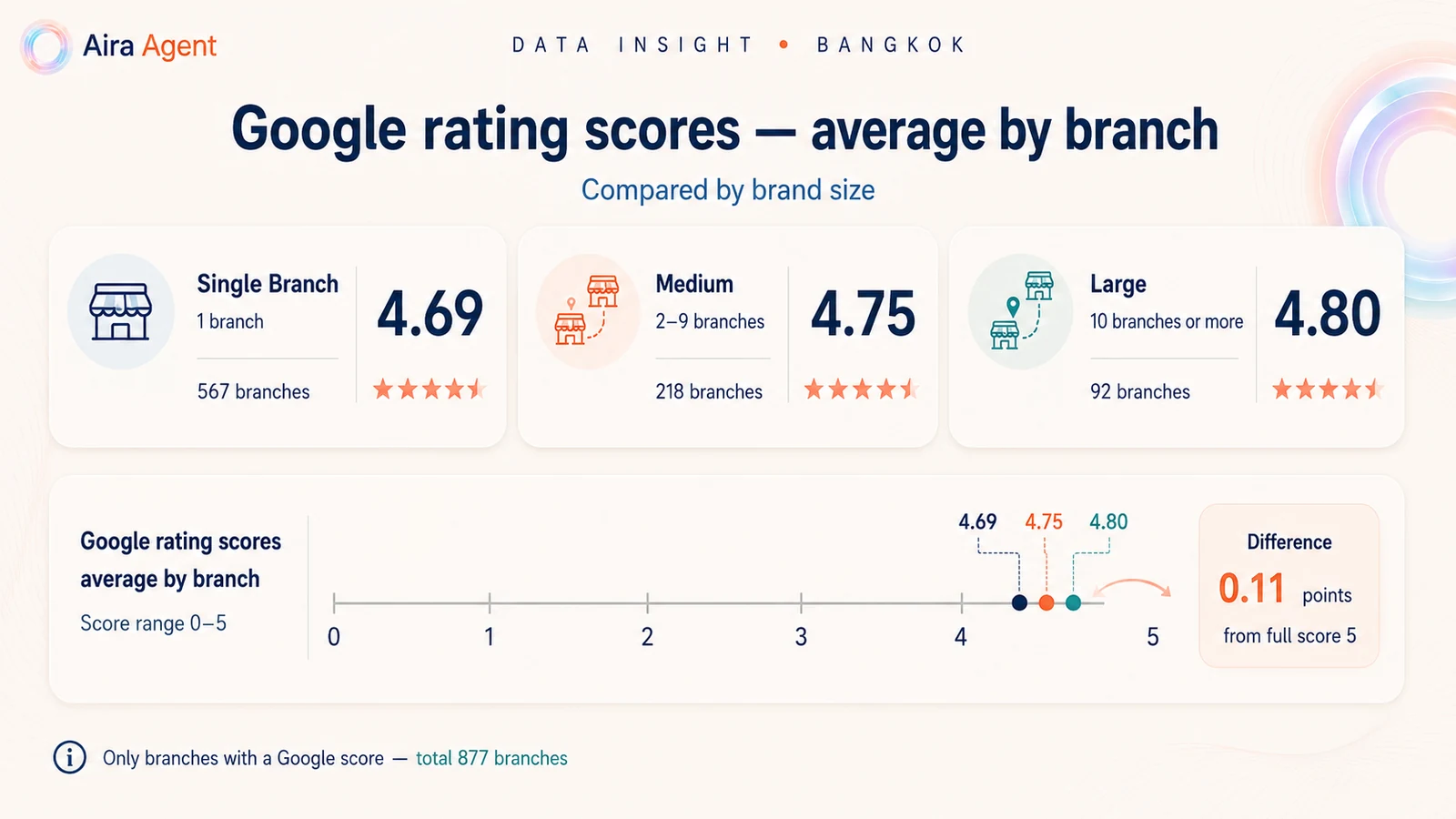
Average Google rating per branch, by brand size
What these numbers hint at is this: if you believe you can hold on to your current quality even as you add branches, the data says you have every right to go up against the big chains.
Insight 2 — So where should you open? Min Buri may be a hidden opportunity
To answer this very popular question, we started by ranking the districts where aesthetic clinics cluster the most, and looked at the same time at what kind of clinics sit in each of them.
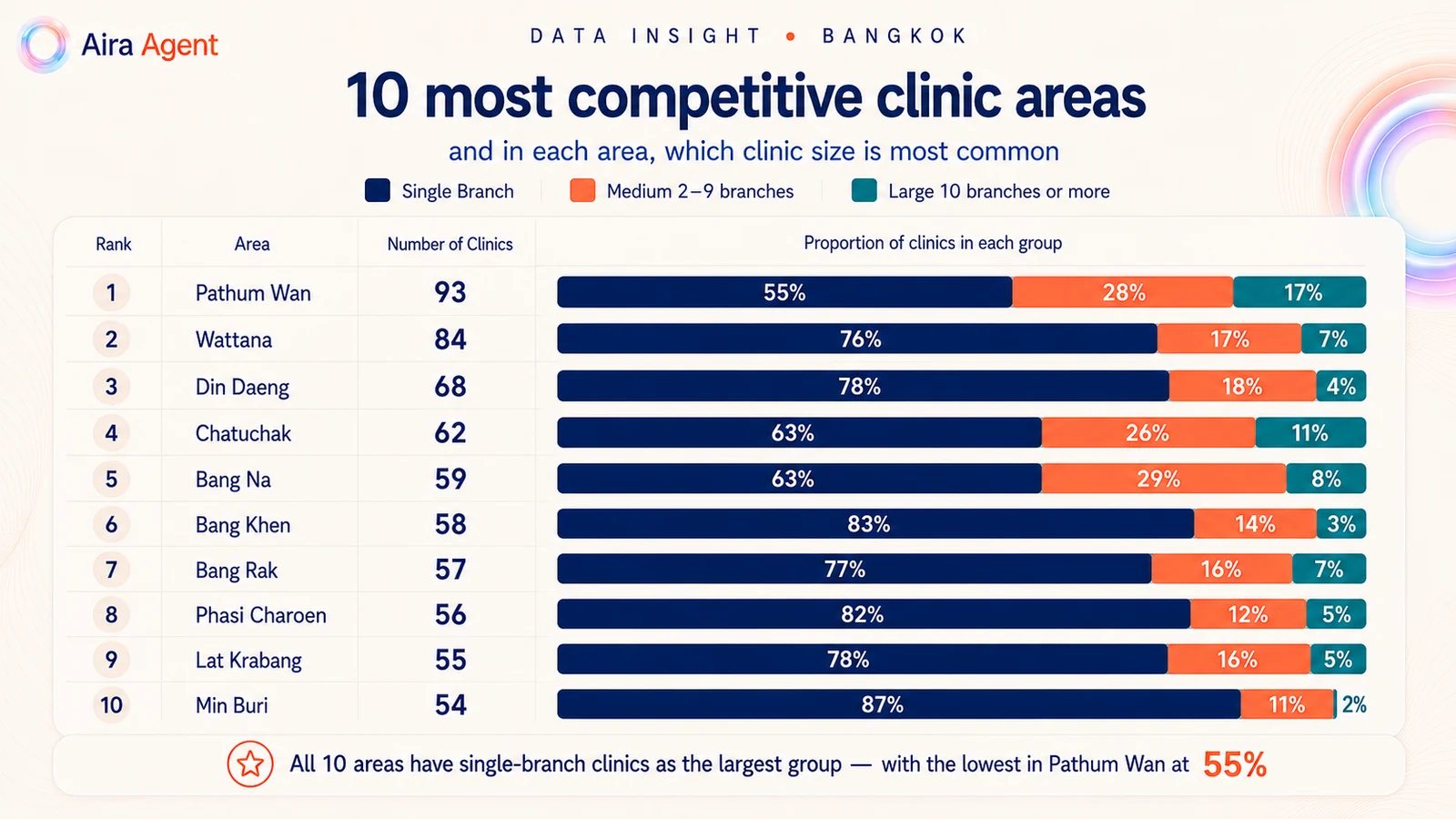
The 10 districts where aesthetic clinics cluster the most, and the mix of clinic types in each
Number 1 is Pathum Wan with 93 clinics, most of them around Siam — a neighbourhood where you can't turn around without seeing a clinic. And last in this group is Min Buri, with 54.
Where do the chains cluster?
If you want to know which locations the market treats as “proven,” the most direct way is to look at where people put their own money down, again and again.
Large chains (10 or more branches) cluster most heavily in Pathum Wan, at 17% of the district, followed by Chatuchak at 11% — the two districts with a meaningfully higher share of large chains than anywhere else.
Medium chains (2–9 branches) cluster in Bang Na, at 29% of the district, followed by Pathum Wan at 28% and Chatuchak at 26% — the three districts where medium-chain concentration stands out from the rest.
It is worth noting that medium chains do not retreat to the outer districts to avoid the large chains; they choose to play on the same field. If you want to try competing where the big brands are, Pathum Wan and Chatuchak are two districts to watch, because that kind of clustering may mean there is a “formula” for running a clinic in those areas that genuinely works.
Min Buri — the district with plenty of people, but nobody doing it well yet
Min Buri is the district we find most interesting in this table.
It is in the top 10 for clinic concentration (54 of them), which means the demand is real. People there use this service — otherwise 54 clinics would not have opened.
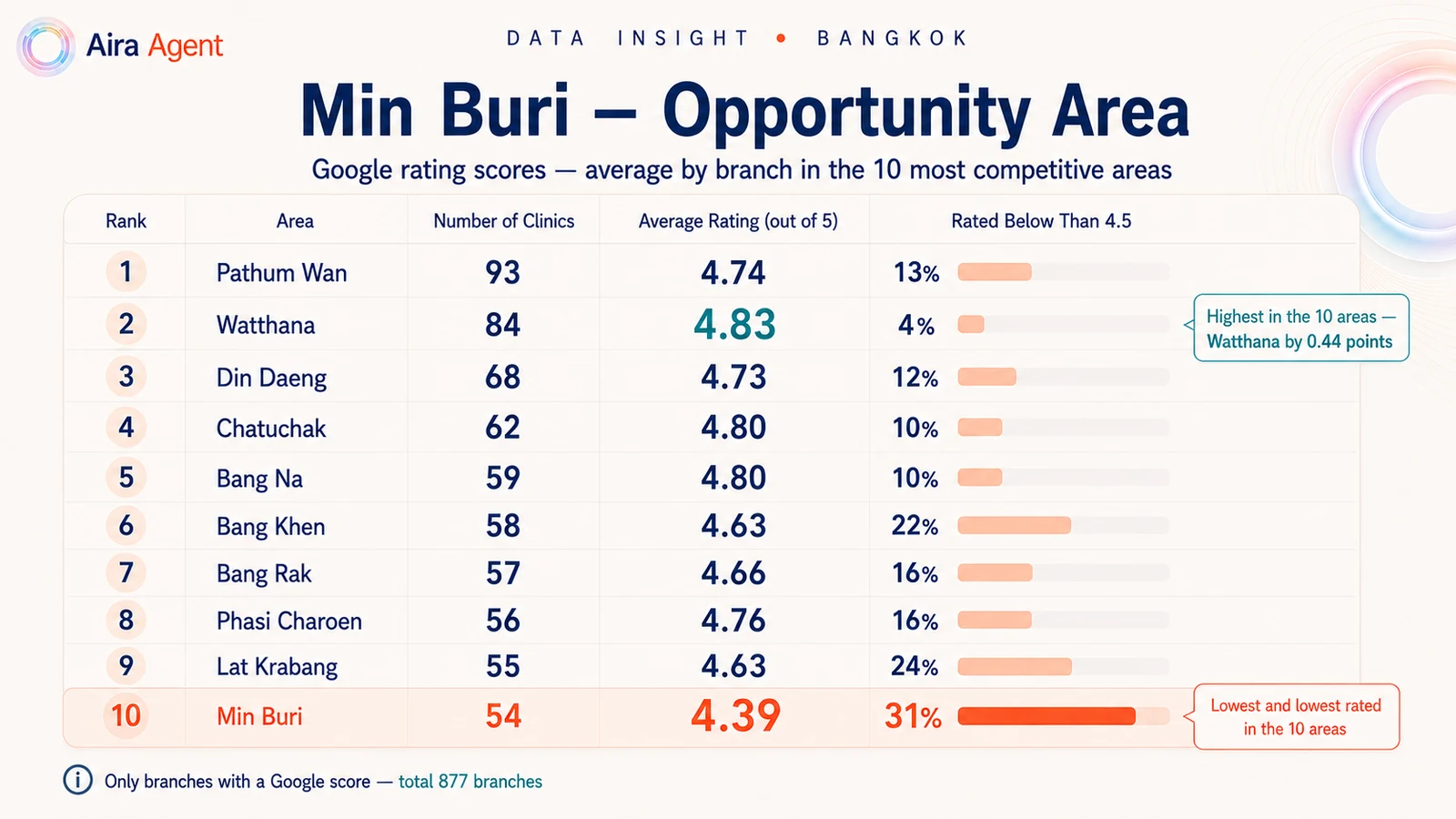
Average Google rating per branch across the 10 densest clinic districts
But then look at the scores.
- Average rating 4.39 — the lowest in the top 10
- 31% of the clinics there score below 4.5 — nearly 1 in 3
- 87% are single-branch clinics · large chains just 2%
For comparison: Din Daeng is also in the top 10 (68 clinics) with a fairly similar market structure, but its average rating is 4.73. That comparison may suggest Min Buri is running into service problems — and whoever can fix them should be able to grow a business there rather well.
Seen the same way, Lat Krabang and Bang Khen are worth a look too.
And if you find that one of the reasons behind customer dissatisfaction is slow replies on chat, or not being able to answer customers around the clock, Aira Agent is another option that can help. We are an AI sales chatbot that helps close sales 24/7 and replies to your clinic's customers within 2 minutes — from general information all the way to consulting customers and booking their appointment with the doctor. If you're interested, you can book a free online consultation with us.
Insight 3 — Your real competitor may not be the large chains
When we think about “competitors,” we usually picture the big brands with the beautiful signage, the ad budget, branches everywhere. But the data says the ones actually next door to you are not that group.
- District median: 83% of the clinics in a district are single-branch brands
- 32 of 39 districts (82%) are more than 75% single-branch
- The median large-chain share within a district is 3%
- And even Pathum Wan, the district with the densest chain concentration in Bangkok, is still 55% single-branch clinics
If the heaviest district looks like that, the rest hardly need saying.
Which means: wherever in Bangkok you open, the clinic next door to you is a single-branch clinic, not a large chain. You don't have to beat the large chains. You just have to be better than the single-branch clinics around you.
That is good news and bad news at the same time. The good news is that the field is far more open than you would think. The bad news is that if we keep our eyes only on the large chains, we may overlook the small brand next door that has done its homework better than us — and turns into the dark horse we have to worry about later.
So I'd invite you to go and walk the area you have your eye on, and survey the competition for real — not just to see which chains have moved in, but to see what the single-branch clinics there do well, and what they don't.
Data source: 1,719 aesthetic clinic branches from 1,047 brands across 39 districts in Bangkok, collected from Google Maps · data as of 20 August 2026 · average ratings are calculated per branch, counting only the 877 branches that carry a Google rating.
Ready to see Aira in action?
Try Aira on LINE — or meet the team in a 30-minute demo.